Now that development workflows are accelerating with AI tools like GitHub Copilot and Claude Code, the traditional logic behind software outsourcing is facing a major shift. Outsourcing software development tasks had long been a way to cut costs and access specialized expertise. However, the surge in the use of generative AI in recent years has automated many tasks.
There is an assumption that AI will completely replace human developers in the next few years. Similarly, some are worried about the true cost of accelerating engineering with AI.
It is true that AI has taken over most of the development tasks, including code generation, deployment, security, documentation, testing, and compliance. But AI cannot replace problem-solving skills and emotional intelligence that human developers can offer. Therefore, let’s take a closer look at the role of software development outsourcing in the AI era.
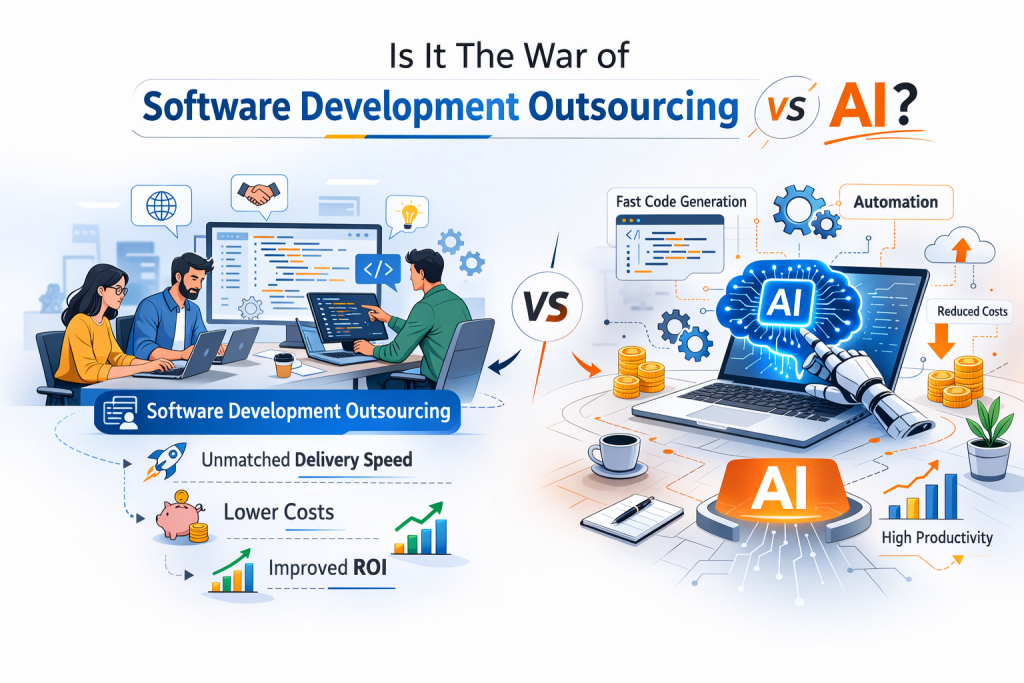
Is It The War of Software Development Outsourcing vs AI?
Generative AI platforms are giving more gains than outsourcing in some key areas. They are offering:
- Unmatched delivery speed
- Lower costs
- Improved ROI
AI can generate code at a super-fast speed that human developers cannot match. For example, GitHub Copilot is boosting developer productivity by 55%. Similarly, advanced coding agents like Claude Code can draft full functions, refactor legacy modules, write tests, and explain complex codebases in seconds. This compresses hours of manual work into minutes, accelerating time-to-market.
Today, AI systems have advanced enough to identify complex, hidden patterns that are undetectable to human evaluators. Take Anthropic’s recent disclosure of what it described as the first documented AI-orchestrated cyber-espionage campaign. According to the company, its own large language model, Claude, played a key role in supporting and accelerating the investigation.
There is no doubt that AI has attracted organizations to deploy generative AI platforms to elevate the in-house team’s productivity. It has become a better alternative to humans for general code generation or basic bug fixes.
Read more: Your AI Assistant Is Confident. Here’s Why That’s Dangerous.
However, a war between software development outsourcing and AI is still unlikely anytime soon. In fact, Gartner predicts that up to 40% of AI agent projects will be terminated by the end of 2027, due to financial, security, and business risks.
Why AI Won’t Replace Outsourcing Anytime Soon?

Some of the key reasons why we won’t see an AI vs outsourcing war are:
Data: AI platforms require an excessive amount of high-quality, domain-specific data. It cannot deliver reliable results without it.
Quality: AI code looks clean and well-organized at first glance, but it can be misleading. These systems may use outdated libraries, fabricate nonexistent packages, overlook established engineering standards, etc. The real cost shows up in review and debugging, as experienced developers can lose significant time tracing AI-generated mistakes. Some reports suggest that corrections can slow down developers by about 19%.
Prompts: It looks straightforward to code with AI by just providing the prompt. However, designing an effective prompting system is far more complex than
jumping on a quick call with an outsourcing partner. Compared to experienced vendors, AI systems don’t naturally challenge assumptions and ask follow-up questions. They also don’t evaluate requests through a broader business lens. They respond to what’s written, not to what’s strategically intended.
Security: AI platforms are coming with built-in cybersecurity safeguards, but those protections aren’t foolproof. Threat actors are always looking for vulnerabilities and misconfigurations to exploit AI systems or manipulate their outputs. So, relying solely on default AI guardrails can introduce risks that require human oversight.
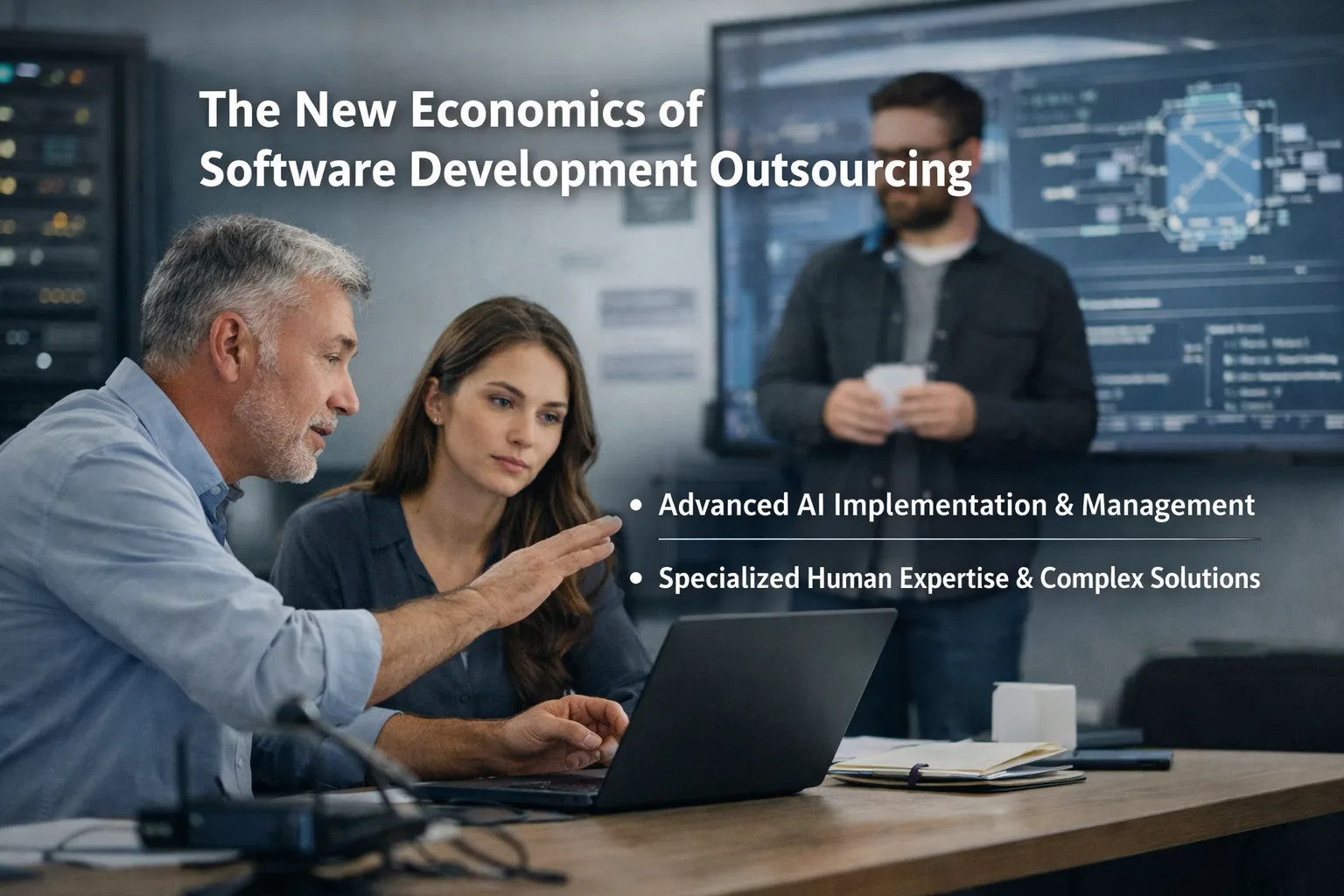
The New Economics of Software Development Outsourcing
Looking back to the pre-AI era, businesses would choose to outsource software development to reduce costs and access top-notch expertise. However, the rapid pace of AI advancements has forced businesses to rethink the reasons to outsource software development.
Now, AI can handle low-complexity work with great accuracy and no human involvement. So, even a small in-house team can use AI development platforms to write and document less complex code. The role of humans remains as supervisor and validator. In some cases, that oversight can be managed in-house. But in many others, it still requires external specialists with deep technical and industry-specific expertise.
What AI Cannot Replace in the Outsourcing Process?
AI offers speed and intelligence, but it cannot handle high-complexity responsibilities such as:
- Designing sophisticated and multi-layered system architectures
- Integrating and maintaining legacy infrastructure
- Engineering long-term scalability strategies
- Navigating cross-border regulatory and compliance frameworks
Development teams can use AI agents as force multipliers in these areas. However, AI lacks contextual judgment, tacit knowledge, and real-world accountability. It lacks lived experience with failed migrations or production outages. So, this is where the economics of outsourcing shift.
When retaining niche expertise as a full-time internal resource is neither practical nor economical, outsourcing becomes a strategic capability decision. In fact, the demand for specialized human expertise is likely to grow, not shrink, for two key reasons:
- AI Itself Requires Expert-Level Engineering
The advancements of AI systems also make their configuration, orchestration, integration, monitoring, and governance evolve into complex disciplines of their own. So, deploying AI in production environments demands architectural foresight, security hardening, alignment with compliance requirements, and performance optimization.
Outsourced service providers often gain broader exposure to diverse AI implementations than most internal teams do. This cross-industry experience becomes invaluable when projects involve rare legacy systems, high-security environments, complex regulatory hurdles, etc.
- The Junior Talent Gap May Create a Future Senior Shortage
AI is absorbing entry-level technical tasks. So, the traditional learning pathway for junior engineers may narrow. However, these repetitive and low-complexity tasks served as a training ground for developing senior expertise.
If AI replaces too much of that foundational experience, organizations risk creating a future shortage of skilled professionals. While junior roles may evolve toward validating AI output rather than generating it, cultivating genuine technical depth remains essential.
For businesses, this means two things:
- Be intentional about which competencies must be preserved internally.
- Recognize that outsourcing may shift from labor arbitrage to expertise acquisition.
In the AI era, outsourcing is more than about reducing costs. It is moving towards securing access to rare knowledge and complex problem-solving capabilities that AI alone cannot provide.
How to Proceed with Outsourcing & AI?
Now that we know the technicalities of outsourcing and AI, the next question is how to proceed with them in 2026 and beyond.
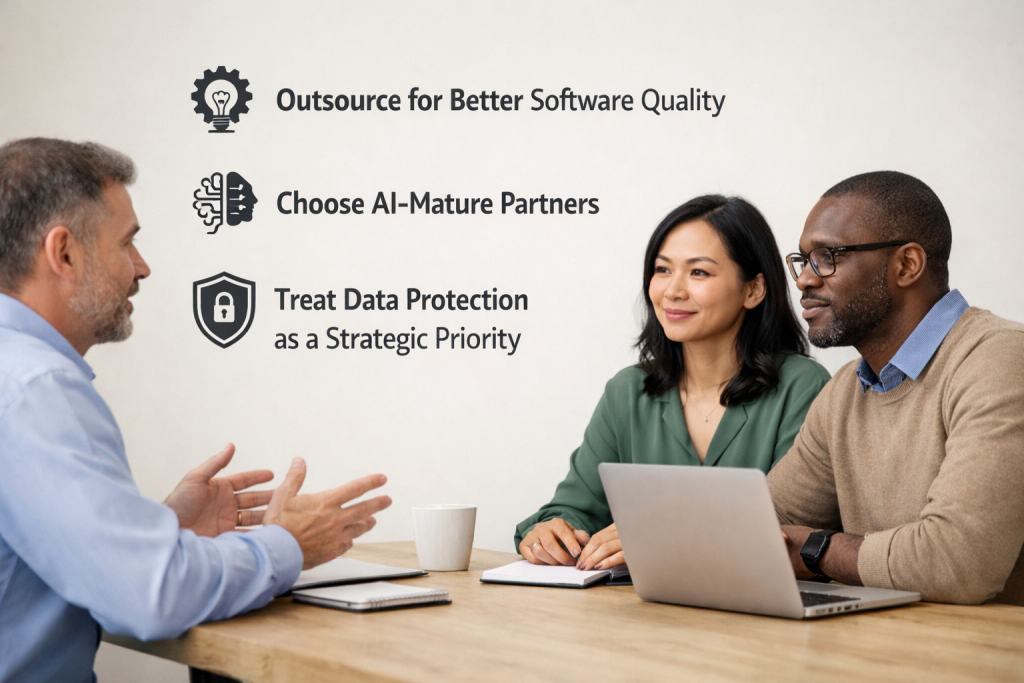
- Outsource for Better Software Quality
Using AI development platforms can pose long-term risks, including exposure to vulnerabilities and increased technical debt. The goal of outsourcing should no longer be labor arbitrage and saving costs. Instead, it should be for capability amplification. The right partner should serve as an extension of your innovation engine, ensuring architectural integrity and long-term sustainability.
- Choose AI-Mature Partners
When choosing software development outsourcing vendors, there is a new evaluation lens to consider, especially for AI-related projects. Beyond delivery capacity, assess whether a partner understands data infrastructure, model governance, lifecycle management, and MLOps.
- Treat Data Protection as a Strategic Priority
The introduction of AI increases the complexity of safeguarding intellectual property and sensitive information. Questions around data ownership, model training inputs, and compliance boundaries have become significant. So, strong outsourcing relationships must include clear accountability frameworks and disciplined data management practices.
Wrapping Up
Competitive advantage in 2026 will not come from choosing AI over humans or outsourcing over in-house teams. It will come from orchestrating them effectively. Organizations that strike the right equilibrium between automation and human expertise will be best positioned to innovate and deliver durable value.
Data Pulse Tech LLC specializes in full-stack development, DevSecOps, and vulnerability research for government agencies. Learn more about our cybersecurity services: DataPulseTech.com