

Organizations are upgrading their infrastructure and tools with emerging technologies, but this is also increasing the vulnerabilities of their IT infrastructure to new cyber threats. In fact, a cyberattack now occurs every 39 seconds. There are many ways to implement cybersecurity, but penetration testing is one of the most effective methods for assessing current security controls and identifying vulnerabilities.
Today, 75% of organizations perform penetration testing to evaluate their security posture. This guide covers the basics, types, process, and benefits of penetration testing.
What is Penetration Testing?
Penetration testing (or pen testing) is an ethical cybersecurity assessment tactic. Its goal is to pinpoint system vulnerabilities by exploiting them as cybercriminals would.
Penetration testing assesses the entire IT infrastructure, including networks, devices, and applications. The experts conduct ethical attacks using real-world scenarios to assess the effectiveness of existing cybersecurity measures against a full-scale attack. As a result, the organization can identify security loopholes and address them before attackers can exploit them.
Objectives of Penetration Testing
- Uncover hidden vulnerabilities in systems and networks.
- Assess the current security strength of the IT infrastructure.
- Meet key compliance standards, including GDPR and PCI DSS.
- Rank risks by exploiting likelihood and business impact.
- Validate incident response and recovery plans.
- Pinpoint all exploitable security weaknesses.
- Assess the impact of cyberattacks on operations and data.
- Measure the effectiveness of existing defenses.
- Strengthen protections against emerging threats.
- Cut costs from breaches and downtime.
- Elevate stakeholder confidence and trust.

Benefits of Penetration Testing
Penetration testing has become a crucial activity that every organization should conduct at least once per year. Organizations that handle more sensitive data should even run pen tests multiple times each year.
The key benefits of penetration testing include:
- Proactive identification of vulnerabilities before attackers exploit them.
- Strengthens overall security posture against evolving threats.
- Ensures compliance with regulations such as GDPR, PCI DSS, and HIPAA.
- Reduces financial losses from breaches, downtime, and recovery.
- Improves incident response readiness through realistic simulations.
- Builds stakeholder trust through a demonstrated commitment to security.
- Delivers high ROI by preventing multimillion-dollar incidents.
- Enhances awareness and training across security teams.
Types of Penetration Testing
Penetration testing is not a one-size-fits-all procedure. Organizations have to perform different types of pen tests for different scenarios, as follows:
Network Penetration Testing
Tests external/internal networks (servers, routers, firewalls) for vulnerabilities like IPS/IDS evasion, SSH, DNS, MITM, and database attacks. It helps protect against network threats.
Web Application Penetration Testing
Scans websites/apps for issues like XSS, broken authentication, SQL injection, and code flaws. It helps prevent data breaches.
Wireless Penetration Testing
Examines corporate Wi-Fi devices (laptops, IoT, phones) for unauthorized access and misconfigurations. It helps secure wireless connections.
Social Engineering Penetration Testing
Simulates phishing, vishing, smishing, and tailgating to test employee susceptibility. Today, 98% of attacks use social engineering.
Physical Penetration Testing
Evaluates building/IT physical security (locks, cameras, barriers) against unauthorized access.
Other Sub-Types of Penetration Testing
Other than the above types, the following are the other three common sub-types of penetration testing:
- Black Box: Testers start blind, with no system information, to mimic external hackers probing for entry points.
- White Box: Full access to code and docs for a thorough internal security check.
- Gray Box: Partial knowledge to simulate insider threats with limited privileges.
Process of Penetration Testing
Penetration testing involves four crucial steps to identify and address vulnerabilities:
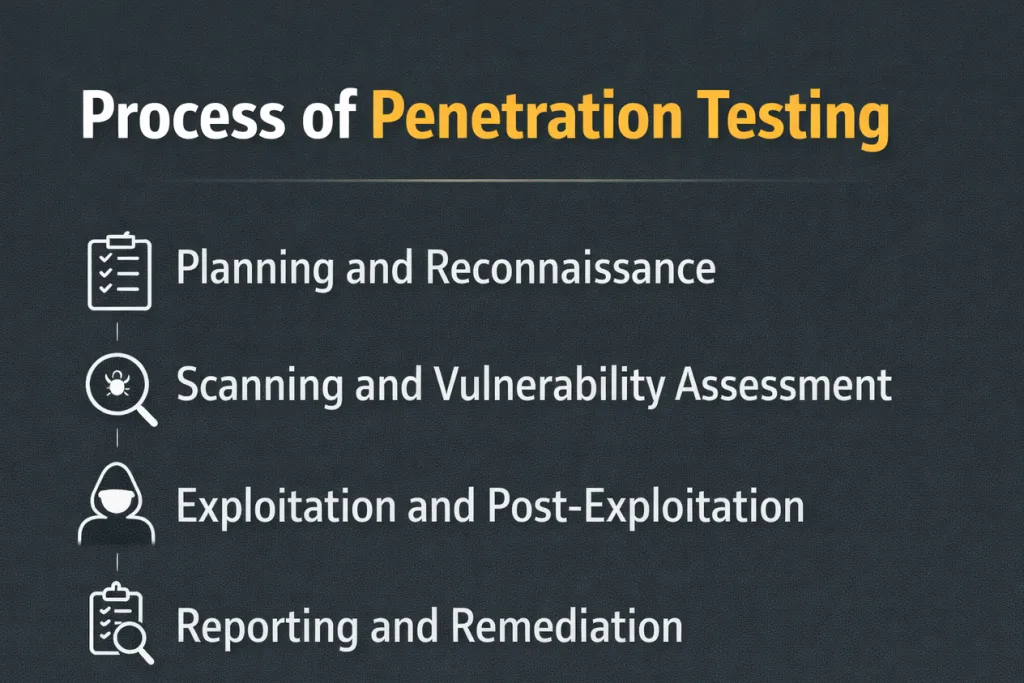
- Planning and Reconnaissance
The first step in penetration testing is planning and reconnaissance. The team begins by deciding the scope and testing methods. Next, they gather data from the underlying systems, including user accounts, network topology, operating systems, and applications.
- Scanning and Vulnerability Assessment
The second step starts with a thorough scanning of the target system. The team uses various tools/techniques, such as Tenable for vulnerability assessment and Nmap for network scanning. The goal is to identify all vulnerabilities that cybercriminals can exploit to gain access. Once complete, the team prioritizes vulnerabilities based on their impact.
- Exploitation and Post-Exploitation
The team now begins exploiting the vulnerabilities to gain unauthorized access using tactics real attackers would use. They simulate real-world attacks using various tools, then examine the consequences to demonstrate the full impact, such as stolen data or a complete system takeover.
- Reporting and Remediation
Finally, the team creates a comprehensive report that explains the entire process, identifies vulnerabilities and potential exploitation results, and more. The team will also proceed with remediation and addressing identified vulnerabilities.
Wrapping Up
Penetration testing is increasingly important in 2026, as cybercriminals have more entry points to exploit. Therefore, it is more important than ever to prioritize frequent pen testing to become proactive in defending against evolving threats. So, schedule your penetration test today and stay ahead of cyber threats.
Data Pulse Tech LLC specializes in full-stack development, DevSecOps, and vulnerability research for government agencies. Learn more about our cybersecurity services: DataPulseTech.com